

Safe activity without increasing foot risk
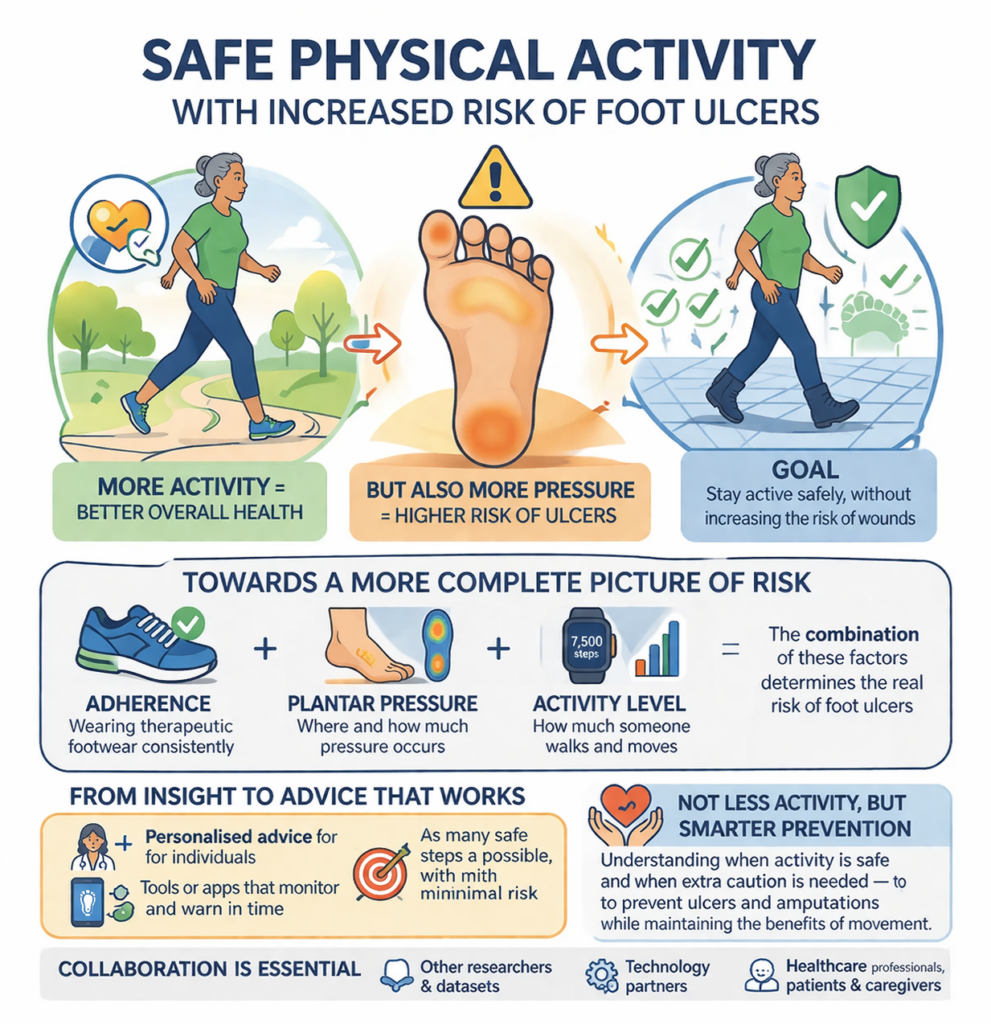
For people with diabetes who are at increased risk of foot ulcers, being physically active is not straightforward. More activity benefits overall health, but it can also increase pressure on the foot and thereby raise the risk of a wound. Touria Ahaouari aims to better understand how people can stay active safely, so that advice on physical activity can be better tailored to the risk of ulcers and amputations.
“My dream is that people at increased risk of foot ulceration can maintain or even increase their physical activity without increasing their risk of ulceration. I find this important because physical activity can bring major health benefits for this group, for example improved cardiovascular health. At the same time, we know that being more active can also increase risk. It is precisely this tension that makes the topic so relevant.
What drives me is that in practice we still lack clear guidance on how to advise people about safe physical activity. We know that pressure under the foot matters, that therapeutic footwear can help, and that people do not always wear that footwear consistently. We also know that the amount someone walks is likely to play a role. What we still do not understand well enough is how these factors work together in relation to ulcer risk. That makes it difficult to give people concrete advice that truly fits their situation.”
Towards a more complete picture of risk
“At the core of my research is the idea that you should not look at one factor in isolation. Not only activity, not only adherence, and not only plantar pressure. It is the combination of these factors that matters. Someone may walk a lot, but wear their footwear consistently and therefore move relatively safely. Someone else may walk less, but wear their footwear irregularly or have an unfavourable pressure pattern. In that case, the risk looks very different. I want to study these factors together, to build a more holistic understanding of what determines foot ulcer risk.
To do this, I use data from different sources. The Maastricht Study has been used to examine associations between diabetes, peripheral neuropathy, physical activity, sedentary behaviour and physical performance. In addition, I use data from the DIALOAD study, where machine learning models have been applied to predict recurrent diabetic foot ulcers. Combining these sources helps us gradually understand how activity, adherence and pressure distribution interact in relation to ulcer risk.”
From insight to advice that works
“Ultimately, I hope this research will lead to more personalised advice on physical activity. Not general recommendations, but advice that fits an individual’s situation. In the longer term, this could lead to a software tool for healthcare professionals, or to an app that monitors behaviour and provides feedback or warnings at the right moment. The goal is to help people take as many safe steps as possible, without unnecessarily increasing their risk of ulceration.
To get there, collaboration is essential. We need other researchers and datasets to validate findings, collaboration with technology partners to develop these applications, and especially input from healthcare professionals, people at risk of foot ulceration and their caregivers. Only then can you create something that is not only technically sound, but also usable in everyday life.”
Not less activity, but smarter prevention
“The impact I hope to make lies in prevention that supports rather than restricts people. Not by mainly telling people what not to do, but by understanding better when activity is safe, when extra caution is needed and how advice can be tailored to the individual. I hope this will help prevent ulcers and amputations, without taking away the benefits of being physically active.”