

How design choices in custom-made footwear can be better substantiated
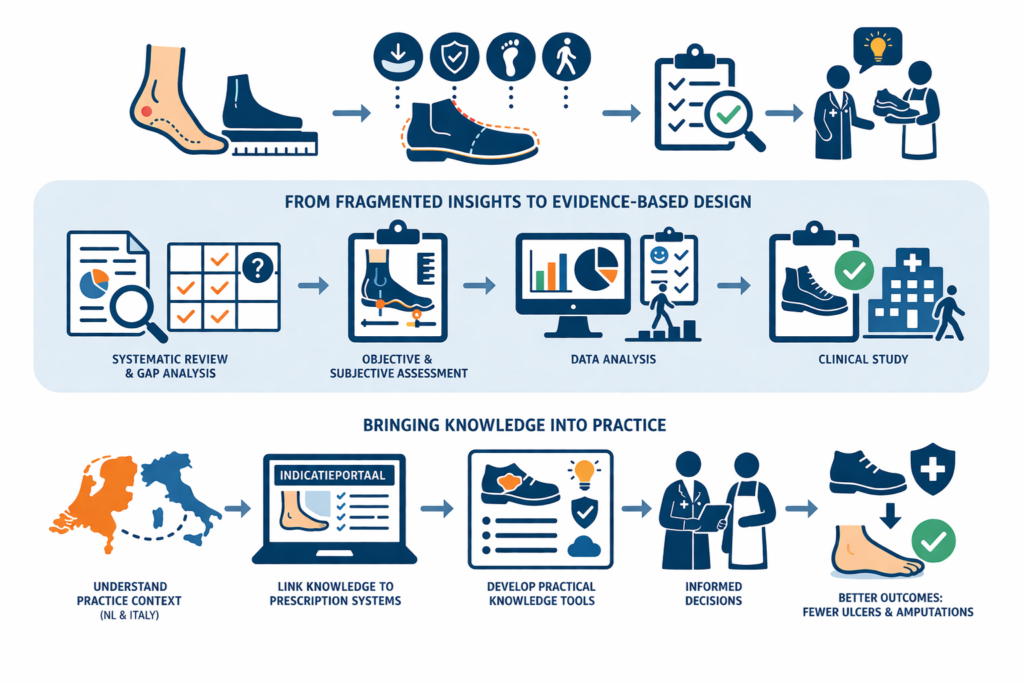
Fully custom-made footwear plays an important role in preventing foot ulcers in people with diabetes at high risk. However, it is still not entirely clear which design elements truly make a difference, not only for pressure reduction and foot protection, but also for fit, comfort and everyday use. Isabella Gigante investigates how these design choices can be better substantiated and how this knowledge can be made usable in practice.
“What I find important is that knowledge about good footwear design does not remain in papers or protocols, but actually reaches the people and systems where design and prescription decisions are made. There is already a lot of knowledge available, but it is not always used when footwear is designed or prescribed. So my goal is not only to develop new insights, but also to make existing knowledge more usable in practice.”
From fragmented insights to evidence-based design
“My ambition is that design choices in custom-made footwear are supported more clearly by evidence. That means design choices are not only based on experience, but also on clear reasoning. Why do you place a metatarsal pad in a certain position? Which materials help reduce shear stress? What shaft height contributes to stability? I want to be able to answer those kinds of questions much more concretely.
My project therefore focuses on both objective and subjective outcomes of custom-made footwear. I look not only at biomechanical effects, such as pressure, dorsal loading and shear forces, but also at fit, comfort, usability and adherence. That combination is essential, because design decisions only have real value if they lead not only to biomechanical benefit, but also to footwear that people can actually use and wear in daily life.
To better understand this, I work in several steps. I start by synthesising existing evidence through a systematic review and a gap analysis. Then I look at methods to assess aspects such as fit more objectively. I analyse existing data on satisfaction, comfort and balance, and ultimately I test optimised custom-made footwear in a clinical study. Step by step, this helps build a clearer basis for decisions about custom-made footwear design.”
Bringing knowledge into practice
“For me, it doesn’t stop there. I also want to understand how decisions about footwear design are actually made in practice. Who ultimately decides which features a shoe will have? At what point in the process does that happen? And how can you present scientific knowledge in a way that is actually useful at that moment?
That’s why I look, for example, at how footwear provision is organised in the Netherlands and Italy. In the Netherlands, I want to better understand how the Indicatieportaal works, because that is a place where knowledge can directly influence prescription and design. .
In addition, I want to develop a visual, user-friendly knowledge tool that answers practical questions from clinicians and footwear providers. Not a long scientific document, but something you can actually use in daily practice. For example: where should you place a metatarsal pad, which design choice improves stability, or how do you improve comfort without compromising biomechanical function? My goal is that people not only know what they choose, but also understand the reasoning behind that choice.”
Better decisions, better outcomes
“The impact I aim for is not only better footwear design itself, but also a better system around those design decisions. If clinicians and footwear specialists have access to clear and usable knowledge at the right moment, they can make more informed choices. Ultimately, I hope this will lead to better substantiated design decisions in custom-made footwear that also prove workable in daily life for patients. And if that knowledge is applied more effectively, we can take an important step towards preventing foot ulcers and amputations.”