From wound closure to true healing
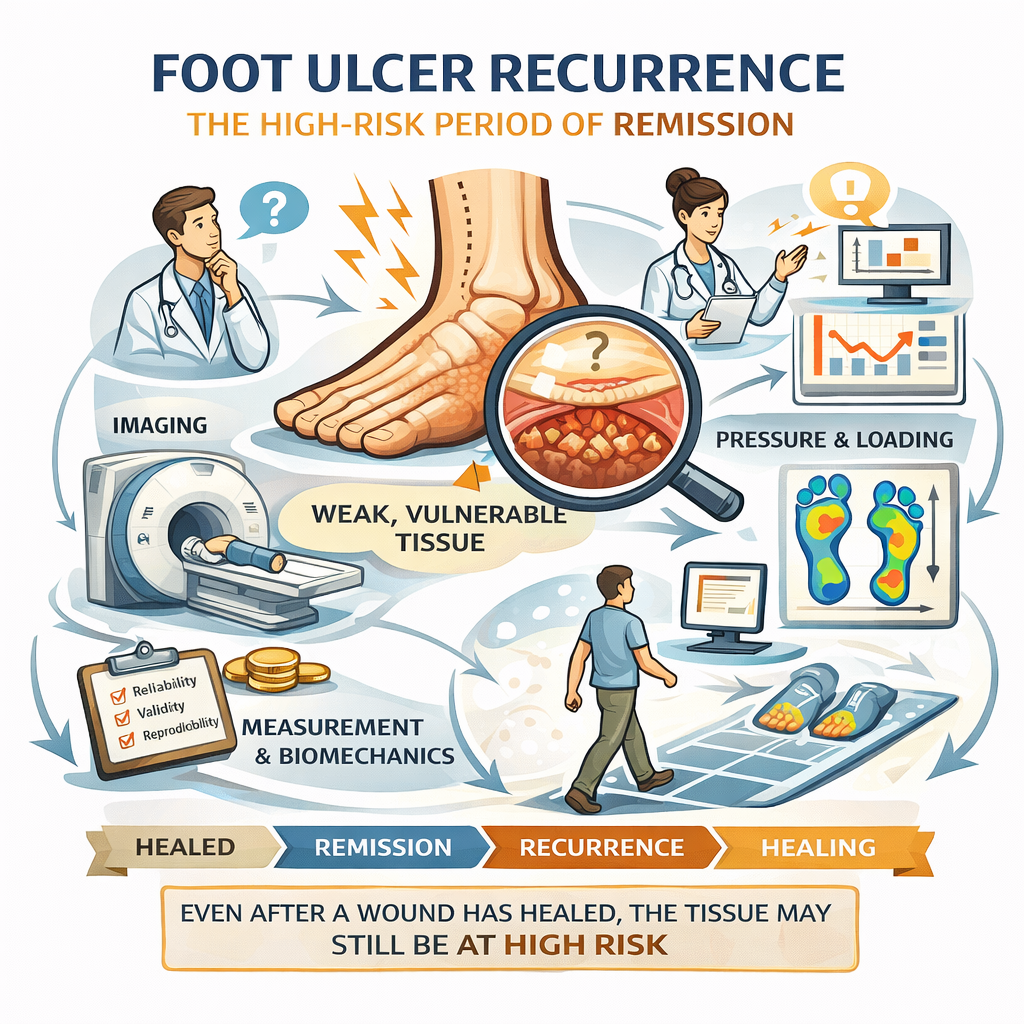
For many people with diabetes, the period just after a foot ulcer has healed is still a time of high risk. Although the wound may be closed, the underlying tissue may not yet have fully recovered. Alessandro Vicentini studies how tissue properties in the foot change from healing into remission, with the aim of improving understanding of why ulcers return so often and how care can better respond to that risk.
“What drives me is the idea that wound closure does not always tell the full story. In practice, healing is often judged by whether the skin has closed, but that may not be enough to understand the condition of the tissue underneath. My research focuses on how we can better assess tissue health during this early phase after healing, when the risk of recurrence is still high.
At the moment, there is still limited knowledge about how the mechanical and structural properties of plantar soft tissue change over time after healing. We know that this remission phase is important, but we do not yet fully understand how tissue recovery, tissue vulnerability and loading of the foot are related to each other.”
Looking beneath the surface
“My project focuses on the plantar soft tissues of the foot, especially on properties such as tissue structure, stiffness, elasticity and loading. I want to understand how these properties change from the moment a wound has healed through the first months of remission, and how that may be linked to the risk of a new ulcer.
To study this, I use a multimodal approach. That means I combine different types of measurements, including advanced imaging techniques such as MRI and weight-bearing CT, together with plantar pressure analysis and other biomechanical measurements. By bringing those different sources of information together, I hope to get a better picture of what happens in the tissue during recovery.
One important reason for doing this research is that current measurement methods are still inconsistent. My systematic review showed that there is a lot of methodological variation in the way tissue properties are measured, and that reliability, validity and reproducibility are often not well reported. So before we can apply these methods more widely, we also need to understand which measurements are robust enough to be useful.”
Towards a more objective view of healing
“What I hope to contribute is a more objective way of looking at healing. Instead of relying only on a visual judgement of whether a wound is closed, I want to explore whether tissue properties can help us better understand how well the foot has recovered and whether risk is still present.
That matters for care, especially in the period after healing. If we can better quantify tissue health, that may eventually help clinicians make more informed decisions about follow-up, pressure relief and the risk of recurrence. It could also help us think more carefully about what we mean by healing. Is full epithelialisation enough, or do we also need to consider the quality of the tissue underneath?
The project does not yet provide a final clinical tool, but it does aim to build the foundations for that. My focus is first on developing and identifying valid, reliable and reproducible measurement methods. In the longer term, this may contribute to a more standardised and measurable way of assessing healing.”
From measurement to prevention
“The impact I hope to make lies in improving how we understand the period after wound healing. Recurrence rates are high, and that suggests we need to look more closely at what is happening in the tissue during remission. If we understand that process better, we may also become better at identifying risk earlier and preventing new ulcers and amputations.
Within DIALECT, the next steps are to continue developing these measurements and to monitor tissue properties over time. I want to study how tissue properties evolve longitudinally and how they may be associated with healing or ulcer recurrence. At the same time, I think it is important to stay connected to clinical practice and to understand what clinicians already know about tissue quality and wound healing, and where the main knowledge gaps are.
For me, the research becomes valuable when it helps bridge the gap between measurement and care. I hope this work can contribute to a better, more objective understanding of healing, and in the longer term support care that is more precisely aimed at preventing recurrence.”