

Smart monitoring to stay ahead of damage
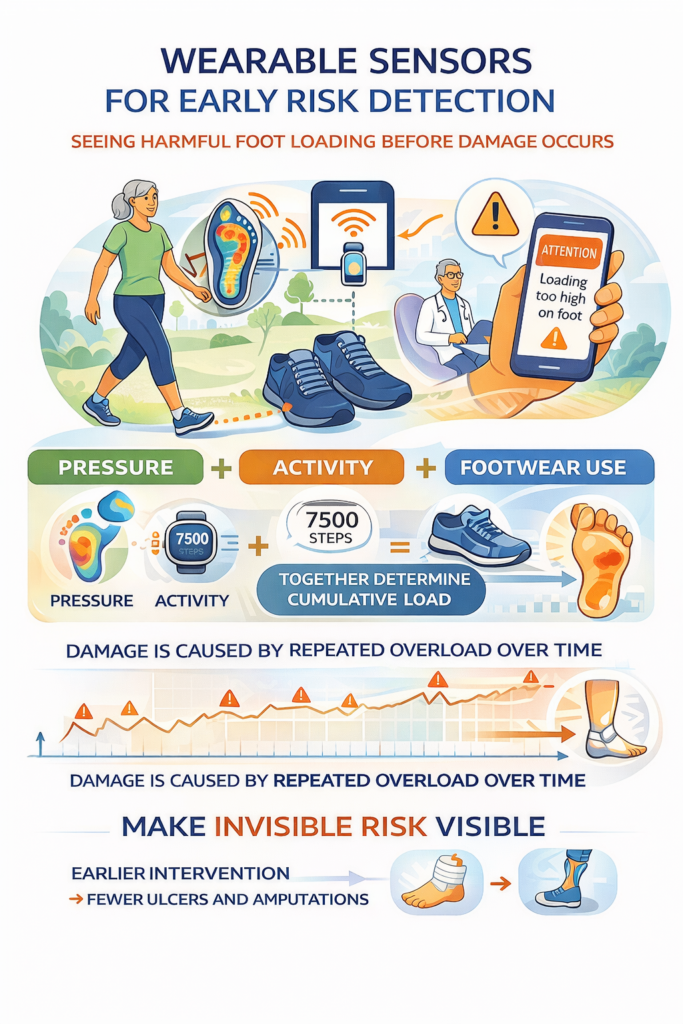
For people with diabetes who are at high risk of foot ulcers, it is still unclear when everyday loading of the foot becomes harmful. Sergio Catalano is developing wearable sensor technology that continuously measures pressure, activity, and footwear use, with the aim of making harmful loading visible earlier in daily life.
“What motivates me is that with diabetic foot ulcers, we often recognise the problem only after damage has already occurred, while the real challenge is to see earlier when everyday loading starts to become harmful. A foot ulcer is not something minor: recovery often takes a long time, treatment is intensive, and in severe cases it can lead to amputation. I want to contribute to an approach that helps us understand more clearly what happens before damage becomes visible.
At the core of my research is long-term monitoring in daily life. We know that biomechanical factors are important, but we still do not fully understand how they contribute to recurrent ulcers in real-world situations. That is why I look at how pressure, activity and footwear use interact over time in everyday life. By measuring these factors together over longer periods, you can better understand when the load on foot tissue becomes problematic.”
From single measurements to continuous monitoring
“What is new in this approach is that we do not measure load at a single moment, but over time in real-life conditions. It is not about a short laboratory measurement, but about what happens when someone is simply walking, standing, wearing their footwear, or not. Using wearable sensors, we aim to better estimate cumulative plantar tissue stress: the total load over time. This matters because damage is often not caused by a single event, but by repeated overload.
For me, it is not only about developing sensors. I want to move towards a complete system: a way of measuring, interpreting and translating data into signals that are actually useful in practice. In the future, I envision a combination of smart insoles or other wearable sensors with a system that detects risk in real time, alerts patients, and informs healthcare professionals when additional attention is needed.”
Making invisible risk visible
“The impact I hope to make lies in making visible what often remains unnoticed. If you can better track when load on the foot becomes too high, you can also act more effectively. That could make it easier to intervene earlier, before repeated overload turns into tissue damage, ulceration or worse outcomes.
To achieve this, collaboration is essential. You need healthcare professionals to ensure it fits clinical practice, researchers from other disciplines to strengthen the evidence, and patients to understand what works in daily life. That is why co-creation is so important. You can build something technically strong, but if it is not usable for the people who need it, its impact will be limited.
Ultimately, I hope this work helps us better understand how everyday patterns of pressure, activity, and footwear use build up into harmful overload over time. If we can see that more clearly, there is also more opportunity to act in time, before small signals turn into major problems.”