

The best factory-made shoe for people with diabetes at moderate to high risk
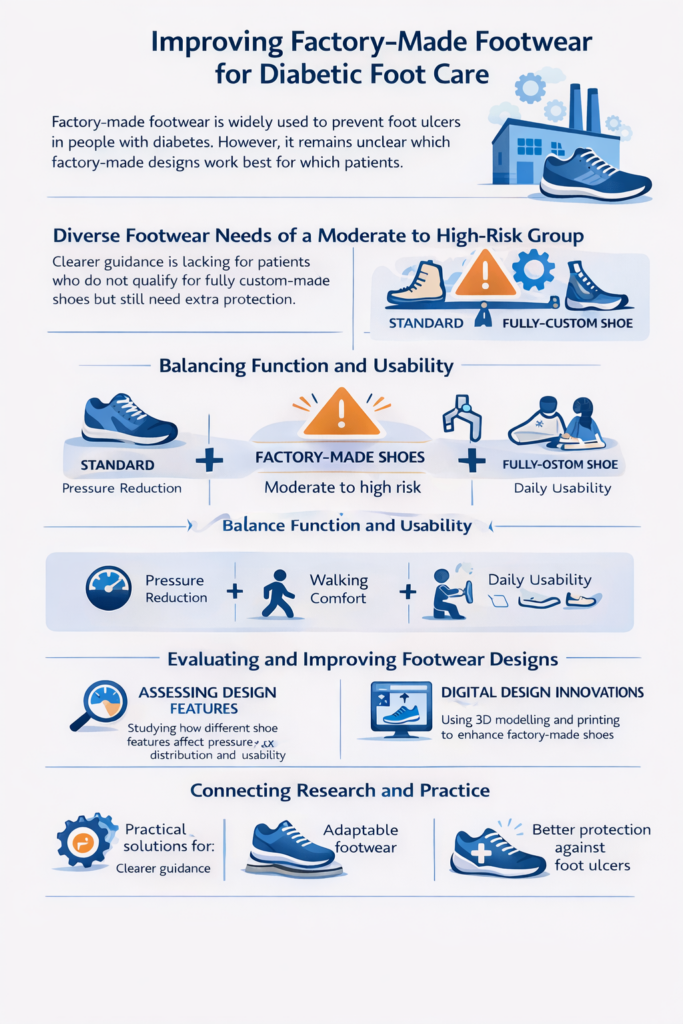
Factory-made footwear is widely used to help prevent foot ulcers in people with diabetes. However, it is still not clear which factory-made designs work best for which patients in practice. Hadi Sarlak investigates how these footwear solutions can be better designed and more strongly evidence-based for people at moderate to high risk of foot ulcers.
“What stands out to me is that factory-made footwear is widely used in care, but we still know too little about which design features actually make a difference for different patients. We know these shoes can reduce pressure under the foot, but the interaction between the foot, the shoe, the materials and the individual is much more complex than we often assume.”
A group that falls in between
“There is a large group of patients who do not qualify for fully custom-made footwear, but still have an increased risk of developing ulcers. In addition, there are patients with a history of ulcers but a relatively ‘standard’ foot shape, who also rely on factory-made footwear. For these groups, we still lack clearly substantiated guidance on which factory-made designs are most appropriate.
That is why my research focuses on evaluating existing shoe designs and developing improved versions. I look at how different shoe features influence pressure distribution, how people walk in these shoes and how usable they are in daily life. For factory-made footwear, that matters especially because these designs need to work not just biomechanically, but also for a broad group of users in everyday practice.
I also work with modular components and digital design tools, such as 3D modelling and 3D printing, to explore new possibilities in footwear design. These techniques make it easier to better match shoes to individual needs, while still keeping them suitable for broader application.”
Bridging research and practice
“A key part of my work is connecting research and industry. There is a lot of knowledge in both fields, but it is not always translated into factory-made products that are clinically validated and clearly matched to the needs of this patient group. By working closely with clinicians and footwear manufacturers, I aim to contribute to solutions that are both technically sound and practically applicable.
In addition, I am working on what we call the Modular Footwear Setup, a tool to better map individual user needs. This can support both healthcare professionals and manufacturers in making more informed decisions about footwear.
My goal is to contribute to footwear solutions that are not only technically effective, but also realistic and practical for the people who rely on them. If we can better match footwear to what people need, we can take an important step in preventing foot ulcers and amputations.”