
Background
For people with diabetes who have already had a foot ulcer, the risk of developing a new one remains high. Many of these patients are prescribed fully custom-made footwear to help prevent recurrence. Yet for a substantial group, a new ulcer still develops within a year. This raises an important question: how well does this footwear work in practice, and where is there room for improvement?
Designing fully custom-made footwear involves many decisions. These include where to place a metatarsal pad, how to construct the sole, which materials to use, and how to achieve the right fit. In practice, such decisions are often based on experience and craftsmanship. While this is valuable, it is not always clear how these design choices should be made, or how they affect pressure distribution, comfort, and everyday use.
This project focuses on that exact question. Isabella Gigante, PhD candidate at Amsterdam UMC, investigates which elements of custom-made footwear truly contribute to preventing new foot ulcers, and how this knowledge can be better applied in clinical practice.
Approach
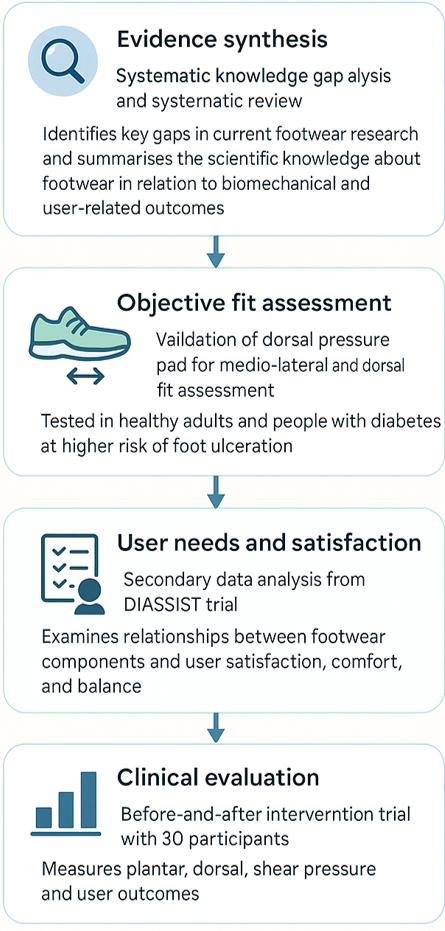
To address this, Gigante first brings together what is already known. Through a systematic review and a gap analysis, she examines which effects of different footwear components have already been studied, and where important knowledge gaps remain. This provides a clear starting point for further research.
A key part of the project then focuses on footwear fit. In daily practice, fit is often difficult to assess objectively, even though it plays an important role in comfort, adherence and protection. Gigante is therefore working on a method to better measure the fit of footwear at the top and sides of the foot.
In addition, the project looks closely at the user’s perspective. Using data from the DIASSIST study, she analyses how different footwear characteristics relate to satisfaction, comfort and balance. This helps to identify which design features are not only biomechanically effective, but also experienced as usable and comfortable in daily life.
Finally, these insights are tested in practice. In a clinical study, people with diabetes at high risk of ulceration receive optimised custom-made footwear. The study evaluates not only biomechanical outcomes, such as plantar, dorsal and shear pressure, but also fit, comfort, usability and whether the footwear is actually worn.
This combination helps link footwear design more directly to both measurable effects and daily-life use.
From insight to care that fits better
For healthcare professionals, this research can help to better support decisions in custom-made footwear. Many design choices are currently based on experience, while clinicians and footwear specialists continuously need to determine what works best for an individual patient.
By gaining more insight into how different footwear components perform, it becomes easier to substantiate why one design choice may be preferable to another. It can clarify which adjustments effectively reduce pressure, which factors influence comfort and adherence, and how these aspects are connected.
The project therefore not only focuses on generating new knowledge, but also on how that knowledge can be applied in practice. In the Netherlands, Gigante examines how knowledge is used within systems such as the Indicatieportaal, where decisions about prescription and design are made. She is also developing a visual, practical tool to support clinicians and footwear providers in making informed design choices.
In this way, the project aims to contribute to custom-made footwear that is not only technically well founded, but also supported by clearer design decisions and better aligned with the realities of daily use. Ultimately, this supports the shared goal of preventing new foot ulcers and amputations.
Research Team
The project is carried out at Amsterdam UMC, Department of Rehabilitation Medicine, under the supervision of Prof. Sicco Bus and Dr. Jaap van Netten. This research group has extensive expertise in diabetic foot disease, ulcer prevention, footwear design and gait analysis.
The project involves collaboration with several external partners, including Vibram, Podartis, Novel and the Shareborg Group. These partners contribute expertise in materials, manufacturing, measurement techniques and practical implementation. This collaboration helps to bring together technical knowledge, clinical expertise and user perspectives.
Amsterdam University Medical Centers
Amsterdam UMC is the largest hospital and one of the leading medical research institutions in the Netherlands. The research is embedded within Amsterdam Movement Sciences, where fundamental and clinical research on human movement are combined. With facilities such as a motion analysis laboratory, advanced imaging technologies and medical physics, Amsterdam UMC provides a strong environment for research that is directly relevant to clinical practice.

Doctoral Candidate
Isabella Gigante
Recruiting organisation: Recruiting organisation: Amsterdam University Medical Centers, location University of Amsterdam, Department of Rehabilitation Medicine, Meibergdreef 9, 1105AZ Amsterdam, The Netherlands.
Hosts: Prof. dr. Sicco A. Bus, dr. Jaap van Netten
Duration: 42 months
Secondments: Secondments: Vibram SpA, Milano, Italy (2 weeks); Podartis, Montebelluna, Italy (2 Weeks): Novel, Germany (1 month); Shareborg group, Amersfoort, the Netherlands (3 months)
Summary: The risk of developing a foot ulcer in people with diabetes is highest in those who have just healed from one. Many of these people are prescribed with custom-made footwear to help prevent ulcer recurrence. However, despite this treatment, ulcer recurrence incidence is high at 40% in one year. In this project, the doctoral candidate investigates how specific footwear components influence both biomechanical and user-related outcomes. Through evidence synthesis, sensor validation, secondary data analysis, and a clinical intervention study, the candidate develops and evaluates a data-driven, user-centred footwear design approach to improve effectiveness, satisfaction, and sustainability.